

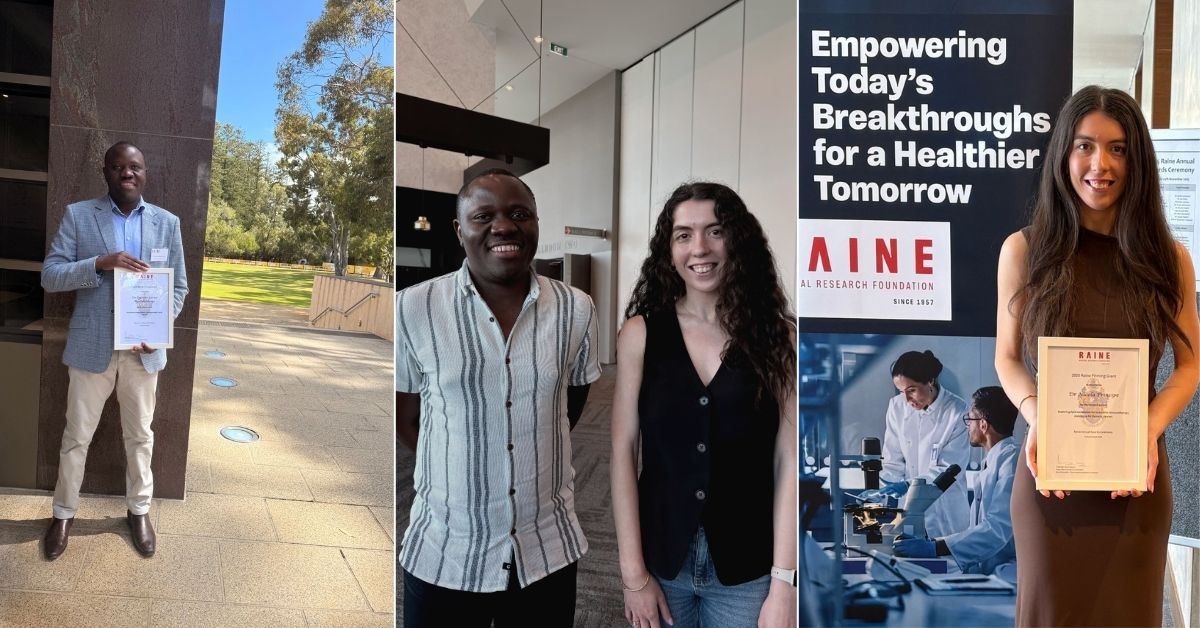
Two researchers from the National Centre for Asbestos Related Diseases (NCARD) and the Institute for Respiratory Health (IRH) have been awarded prestigious Raine Priming Grants to advance their innovative cancer research.
Dr Nicola Principe (IRH, NCARD) received $238,159 for her project exploring how lipid metabolism could be used to address immunotherapy resistance in thoracic cancers, while Dr Francois Xavier Rwandamuriye (UWA, NCARD) was awarded $236,409 to develop mRNA-based neoantigen cancer vaccines.
The grants, administered by the Raine Medical Research Foundation, support early and mid-career researchers undertaking health and medical research that benefits Western Australians. Both projects aim to address key challenges in cancer treatment where current therapies are limited.
Targeting immunotherapy resistance
Immunotherapy has transformed cancer care by helping the immune system recognise and respond to tumours. However, fewer than 20 per cent of patients with thoracic cancers, including mesothelioma and lung cancer, experience long-term benefit. Understanding why most patients do not respond remains a significant question in cancer research.
Dr Principe’s research focused on why some cancers are resistant to immunotherapy. Her team has discovered that regulatory T cells – immune cells that suppress the body’s cancer-fighting response – depend on fats and cholesterol to survive inside tumours. Unlike cancer-fighting immune cells, these suppressive cells are adapted to the low-glucose tumour environment.
By targeting these pathways with existing cholesterol-lowering medications such as statins, the research aims to disable these suppressive cells and increase the number of patients who respond to treatment. Because these drugs are already approved and have established safety profiles, any promising findings may be translated into patient care more efficiently than new drug development.
I’m grateful for this support from the Raine Medical Research Foundation. This funding will enable us to better understand therapy resistance and explore new ways to improve responses to treatment.
Nicola Principe, NCARD
Personalised cancer vaccines
Dr Rwandamuriye’s project uses the same mRNA technology that underpinned COVID-19 vaccines to develop personalised treatments for cancer. His approach targets neoantigens—proteins found only on cancer cells—training the immune system to recognise and respond to tumours while leaving healthy tissue unaffected.
In contrast to conventional therapies like chemotherapy, which affect both healthy and cancerous cells, neoantigen vaccines aim to provide a more targeted approach with fewer side effects. Because these protein targets are unique to cancer cells, the immune response is highly specific.
Building on NCARD’s pioneering work identifying neoantigens in mesothelioma and lung cancer, Dr Rwandamuriye will design and optimise mRNA constructs that can deliver multiple cancer targets in a single vaccine. A key focus is developing strategies to guide the mRNA so it activates only in immune cells that play the most important roles in anti-tumour responses.
While dendritic cells – the immune system’s “teacher” cells – are commonly targeted, the contribution of other immune cells remains unclear. By studying this, the project aims to identify the best strategies for delivering and formulating personalised mRNA vaccines.
The speed and adaptability of mRNA vaccine production, as seen during the pandemic, make the technology well-suited to personalised cancer treatment, where each vaccine must match an individual’s tumour.
As an early-career researcher, I appreciate the opportunity this grant provides to explore new approaches that could improve outcomes for patients.
Francois Rwandamuriye, NCARD
Supporting Western Australian research
The Raine Priming Grants provide early and mid-career researchers with funding to develop innovative health research projects. Both Dr Principe and Dr Rwandamuriye are members of NCARD, a centre within the Institute for Respiratory Health and the University of Western Australia that brings together researchers focused on improving outcomes for people affected by asbestos-related diseases.
These grants will support both researchers to pursue innovative science with the potential to inform future treatment strategies for patients with limited options.

